
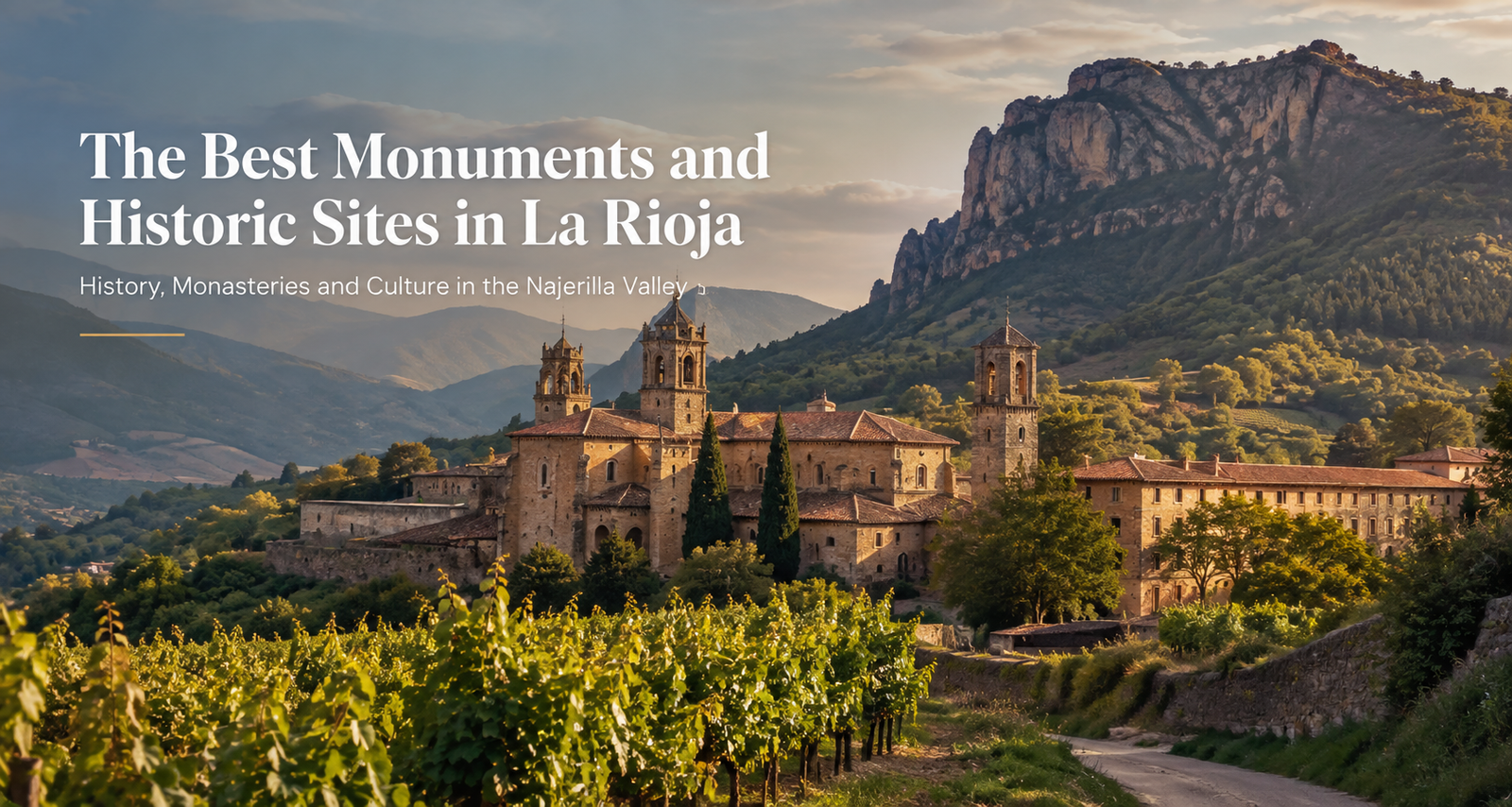
Discover the best historic sites and monuments in La Rioja, from Santa María la Real to the UNESCO monasteries of San Millán and the Najerilla Valley.
The Best Monuments and Historic Sites in La Rioja, Spain
La Rioja is famous around the world for its wine, vineyards and beautiful cycling roads. But beyond the wineries lies a fascinating region shaped by Roman settlements, medieval kingdoms, monasteries, pilgrimage routes and centuries of cultural history.
For cyclists, La Rioja offers a unique opportunity to combine riding through spectacular landscapes with discovering some of northern Spain’s most important historical monuments.
One of the best areas to experience this combination is the Najerilla Valley, a historic landscape where Roman heritage, medieval monasteries and mountain scenery come together.
From the royal monastery of Santa María la Real in Nájera to the UNESCO World Heritage monasteries of San Millán de la Cogolla, the region is full of places worth discovering.
A Journey Through the History of La Rioja
La Rioja occupies a strategic position between the Ebro Valley and the mountains of northern Spain. Throughout history, its location made the region an important crossroads between different cultures and kingdoms.
The Romans established important settlements here, medieval kings founded monasteries and towns, and the Camino de Santiago brought pilgrims through the region for centuries.
The result is an extraordinary cultural landscape where Roman remains, Romanesque churches, Gothic monasteries and medieval towns can still be found alongside vineyards and mountain roads.
For cyclists, this makes La Rioja much more than a wine destination.
It is a place where every ride can become a journey through history.
The Najerilla Valley: The Historical Heart of La Rioja
The Najerilla Valley is one of the most interesting areas in La Rioja for combining cycling, history and nature.
The River Najerilla runs through the valley, connecting Nájera with the foothills of the Sierra de la Demanda. Along the valley are some of the most important religious and historical monuments in the region.
Among them are:
- Santa María la Real in Nájera
- The Roman heritage of Tritium Magallum
- The Monastery of Cañas
- The Monasteries of Suso and Yuso
- The Monastery of Valvanera
The landscape changes dramatically as you move from the vineyards and agricultural plains around Nájera towards the forests and mountains of the upper Najerilla.
This combination of cultural heritage and varied landscapes makes the valley particularly attractive for cycling.
Santa María la Real in Nájera
One of the first monuments to visit in the Najerilla Valley is the Monastery of Santa María la Real in Nájera.
Founded in 1052 by King García Sánchez III of Nájera and his wife Estefanía de Foix, the monastery became closely connected with the medieval Kingdom of Nájera-Pamplona.
According to legend, the king discovered an image of the Virgin inside a cave while hunting. The monastery was subsequently founded around this sacred site.
Inside, visitors can discover the impressive Royal Pantheon, where members of medieval royal families were buried, as well as the remarkable Claustro de los Caballeros, or Cloister of the Knights.
The monastery combines several architectural styles, including Gothic and Plateresque elements, reflecting the long history of the building.
Nájera was also an important medieval centre and an important stop on the Camino de Santiago.
Today, Santa María la Real is one of the most important historical monuments in La Rioja and an ideal starting point for exploring the Najerilla Valley.
Tritium Magallum: La Rioja’s Roman Heritage
Long before the medieval monasteries were built, this area was an important part of the Roman world.
Near modern-day Tricio was the ancient Roman settlement of Tritium Magallum, also known as Tritium Megallum or «Tricio the Great».
Tritium became particularly famous for its pottery production. Its workshops produced terra sigillata, a distinctive type of Roman ceramic that was distributed across the Roman Empire.
One of the most fascinating reminders of this Roman past is the Basilica of Santa María de los Arcos in Tricio.
Originally built as a Roman mausoleum in the 3rd century, it was transformed into a Christian basilica in the 5th century. Roman architectural elements from Tritium were reused in the building.
This makes Tricio an especially interesting stop for anyone interested in the transition from Roman Hispania to early Christian Spain.
The Monastery of Cañas
Continuing through the Najerilla area, another remarkable monument is the Monastery of Santa María de San Salvador de Cañas.
Founded in 1170, Cañas was one of the earliest Cistercian abbeys established in Spain. The monastery has developed through several architectural periods, with Romanesque, Gothic and later elements visible in the complex.
The Gothic church is particularly impressive because of its enormous windows, which fill the interior with natural light.
The monastery also contains important works of art and historical collections.
Cañas offers a completely different atmosphere from the larger monuments of Nájera. It is quieter, surrounded by countryside and closely connected with the rural landscape of La Rioja.
For cyclists, it is an excellent stop between Nájera and San Millán de la Cogolla.
San Millán de la Cogolla: The Birthplace of Spanish Written Culture
Further into the valley lies one of the most important historical sites in northern Spain: San Millán de la Cogolla.
Here, two monasteries stand at the heart of the cultural history of the Spanish language:
Suso and Yuso.
The two monasteries were declared UNESCO World Heritage Sites in 1997 because of their historical, architectural, religious and linguistic importance.
Monastery of Suso
The older monastery of Suso is located higher on the mountainside.
Its origins are connected with Saint Millán, a 6th-century hermit whose religious community developed here.
The site contains important early Christian and medieval remains and represents centuries of monastic history.
Suso is also associated with the earliest written manifestations of the Spanish language.
Monastery of Yuso
Below Suso stands the larger Monastery of Yuso.
Although an earlier Romanesque monastery existed here, the present building was constructed mainly between the 16th and 18th centuries.
The importance of San Millán goes beyond architecture.
The monasteries are closely associated with the origins of written Spanish and with Gonzalo de Berceo, one of the most important medieval writers in the Spanish language. UNESCO describes San Millán as the place where the first literature in Castilian was produced.
For anyone interested in Spanish history and culture, this is one of the most significant places to visit in La Rioja.
The Valley of the Spanish Language
The landscape around San Millán is sometimes described as the Valley of the Language because of its extraordinary connection with the development of Spanish.
Here, the natural environment and cultural heritage are inseparable.
The valley rises towards the Sierra de la Demanda, with forests, mountain roads and small villages surrounding the monasteries.
For cyclists, this creates a spectacular combination: quiet roads, mountain scenery and some of the most important cultural sites in northern Spain.
Monastery of Valvanera
Further into the mountains, the landscape becomes wilder.
Hidden among the forests of the Sierra de la Demanda is the Monastery of Nuestra Señora de Valvanera, home to the patron saint of La Rioja.
The monastery stands in the upper Najerilla area, surrounded by forests and mountain peaks.
The origins of Valvanera are connected with the discovery of an ancient image of the Virgin. A community of hermits developed around the image before Benedictine monks established themselves at the site in the 10th century.
The present church dates from the 15th century and is surrounded by a landscape that is very different from the vineyards of central La Rioja.
This is one of the places where the cultural and natural sides of La Rioja come together particularly well.
For cyclists, reaching Valvanera also means entering a much more mountainous environment, with forested roads and significant elevation gain.
La Rioja: Where History Meets Cycling
What makes La Rioja special is not simply the number of monuments.
It is the way these monuments are connected by the landscape.
You can start your day surrounded by vineyards near Nájera, visit a medieval royal monastery, discover the remains of a Roman city, cycle through the countryside to the Cistercian monastery of Cañas and continue towards the UNESCO monasteries of San Millán de la Cogolla.
Further into the mountains, the road leads towards Valvanera and the forests of the Sierra de la Demanda.
The official La Rioja tourism authority even highlights a cycling route connecting several of these monuments. The «Monasteries» MTB route starts at Santa María la Real in Nájera and passes through the Cárdenas valley, San Millán de la Cogolla and Cañas before returning towards Nájera.
This is exactly the kind of landscape that makes cycling in La Rioja so rewarding.
You are not simply riding from one destination to another.
You are travelling through more than a thousand years of history.
The Best Historic Sites to Visit in the Najerilla Valley
If you are planning a cycling trip through La Rioja, these are some of the historical highlights worth adding to your route:
1. Santa María la Real – Nájera
A medieval royal monastery with royal tombs, a spectacular cloister and a fascinating connection with the history of the Kingdom of Nájera-Pamplona.
2. Tritium Magallum – Tricio
An important Roman centre famous for its pottery production and the distribution of terra sigillata throughout the Roman Empire.
3. Santa María de los Arcos – Tricio
One of the oldest religious monuments in La Rioja, with origins as a Roman mausoleum before becoming a Christian basilica.
4. Monastery of Cañas
A beautiful Cistercian monastery dating back to the 12th century, famous for its Gothic architecture and extraordinary natural light.
5. Monasteries of Suso and Yuso
A UNESCO World Heritage Site and one of the most important cultural landmarks in Spain, closely connected with the origins of written Spanish.
6. Monastery of Valvanera
A mountain monastery dedicated to the patron saint of La Rioja, surrounded by forests and the peaks of the Sierra de la Demanda.
Discover La Rioja by Bike
The best way to experience this part of La Rioja is to combine its cultural heritage with its roads, vineyards and mountains.
At Vamos Bike Tours, we design cycling experiences that allow riders to discover La Rioja beyond the traditional wine route.
From the vineyards around Nájera and Haro to the historic monasteries of the Najerilla Valley and the mountain landscapes of the Sierra de la Demanda, our routes combine cycling, culture, food, wine and local experiences.
If you want to discover the historical heart of La Rioja by bike, the Najerilla Valley is an ideal place to start.
Ride through history. Discover La Rioja by bike.
By Hugo VBT| August 2026