
Cycling in Shikoku, Japan: From the Shimanami Kaido to the Iya Valley
When most people think about cycling in Japan, they probably imagine the famous Shimanami Kaido.
And for good reason.
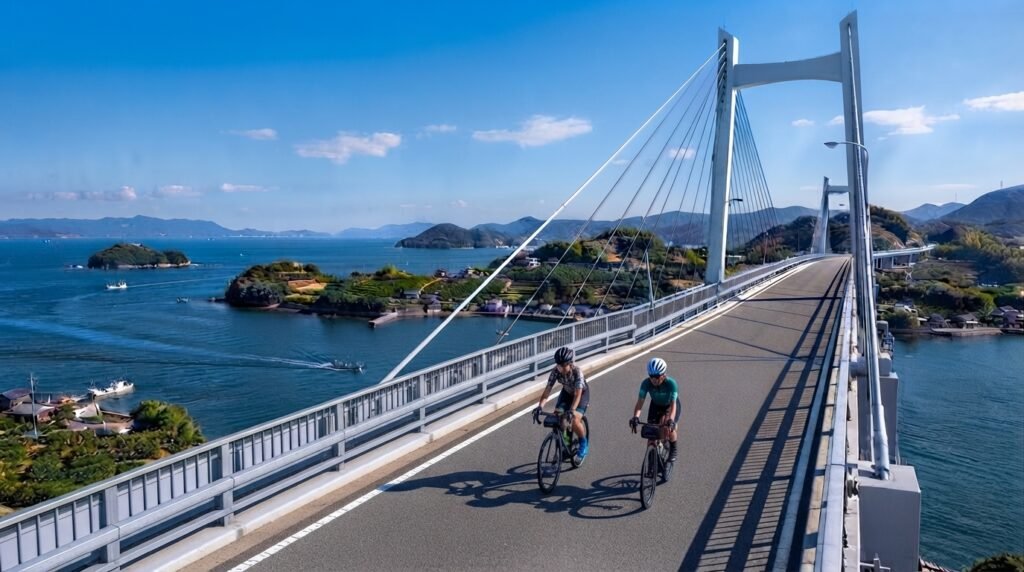
This spectacular cycling route crosses the Seto Inland Sea, connecting the Japanese island of Honshu with Shikoku through a series of bridges and islands. The route is around 70 kilometres long and is one of the best-known cycling destinations in Japan.
But the Shimanami Kaido is only the beginning.
Beyond the famous bridges and island roads lies Shikoku, one of Japan’s most rewarding regions for cyclists looking for mountains, quiet roads, traditional villages, hot springs and a slower way of travelling.
At Vamos Bike Tours, our Shikoku Grand Tour combines the iconic Shimanami Kaido with some of the island’s lesser-known landscapes, from Dogo Onsen and Nakatsu Gorge to the remote Iya Valley and the Yoshino River.
Here is why Shikoku deserves a place on your cycling map.
Why Cycle in Shikoku?
Shikoku is Japan’s smallest of its four main islands, but it offers an incredible variety of landscapes.
The island is surrounded by the Seto Inland Sea, the Pacific Ocean and the Uwa Sea, while its interior is dominated by mountains and deep valleys.
For cyclists, this means that a single journey can include:
-
- Scenic coastal roads
-
- Mountain passes and long climbs
-
- Forested valleys
-
- Small fishing villages
-
- Traditional rural communities
-
- Citrus orchards
-
- Historic towns
-
- Hot springs
-
- Quiet roads with very little traffic
Shikoku is also an excellent destination if you want to experience a different side of Japan.
Away from the country’s biggest cities and most famous tourist destinations, the pace becomes slower. Roads become quieter, villages become smaller and the landscape takes centre stage.
Cycling is a particularly good way to explore this part of Japan because you can travel slowly enough to notice the details: a small shrine beside the road, rice fields on a mountainside, an old house in a rural village or a local restaurant that you might otherwise pass without noticing.
The Shimanami Kaido: Japan’s Most Famous Cycling Route
The perfect introduction to cycling in Shikoku is the Shimanami Kaido.
This spectacular route connects Onomichi in Hiroshima Prefecture with Imabari in Ehime Prefecture, crossing six islands in the Seto Inland Sea: Mukaishima, Innoshima, Ikuchijima, Omishima, Hakatajima and Oshima.
The route is famous for its bridges, ocean views and cycling-friendly infrastructure.
Rather than simply riding alongside the sea, you actually cycle across the bridges connecting the islands.
The experience constantly changes.
One moment you are climbing towards a huge bridge, with the blue waters of the Seto Inland Sea below you. A few kilometres later, you are riding through a small coastal village or passing citrus orchards on one of the islands.
The route is around 70 km, and experienced cyclists can complete it in a day. However, taking more time allows you to stop, explore the islands and enjoy the scenery rather than simply trying to reach the finish.
For us, that is what makes the Shimanami Kaido so special.
It isn’t just a famous cycling route.
It is a way of travelling through the Seto Inland Sea.
Cycling Across the Islands
One of the great things about the Shimanami Kaido is how different each island feels.
You can ride along quiet coastal roads, stop in small communities, visit temples and viewpoints, and discover local food and products.
The islands are also known for their citrus production. The mild climate and sea breeze create ideal conditions for growing oranges and other citrus fruits, and vineyards are replaced here by orchards climbing the hillsides above the sea.
The combination of sea, mountains, bridges and small villages makes the route visually spectacular.
And because the cycling route is specifically designed to connect the islands, the experience feels very different from simply following a normal road through Japan.
From Imabari Into the Heart of Shikoku
The real adventure begins when you leave the Shimanami Kaido behind.
From Imabari, the landscape gradually changes.
The coastal scenery gives way to rolling countryside, citrus orchards and small farming communities as you head towards Matsuyama and Dogo Onsen.
Dogo Onsen is one of Japan’s most famous hot spring areas and is associated with a history stretching back more than a thousand years.
After a day of cycling, there is something particularly satisfying about finishing the day in a traditional Japanese onsen.
This is one of the things we love about cycling in Japan.
A cycling holiday doesn’t have to be only about kilometres and elevation.
It can also be about what happens after the ride.
A hot bath.
A traditional dinner.
A small local restaurant.
A quiet evening in a Japanese town.
These experiences are part of the journey.
Into the Mountains: Nakatsu Gorge
From Dogo Onsen, the route heads inland.
This is where Shikoku begins to reveal another side of itself.
The roads become quieter and the landscape becomes increasingly mountainous. Forests, rivers and deep valleys replace the coastal scenery.
One of the highlights is Nakatsu Gorge, a beautiful mountain valley surrounded by dense forest and clear water.
For cyclists, this section offers something completely different from the Shimanami Kaido.
Instead of bridges and ocean views, you have winding mountain roads, forests and long climbs.
Traffic becomes increasingly scarce as you move deeper into the interior.
This is the kind of cycling that makes you feel far away from the usual tourist routes.
The Iya Valley: Remote Mountain Japan
If there is one place that captures the wild side of Shikoku, it is the Iya Valley.
Hidden deep in the mountains of central Shikoku, Iya has traditionally been one of Japan’s more isolated regions.
The valley is surrounded by steep mountains and dense forests, with traditional villages scattered throughout the landscape.
The area is also famous for its historic vine bridges, built using local plant materials and traditionally associated with the remote communities of the valley.
For cyclists, reaching Iya is an experience in itself.
The roads climb deeper into the mountains, the scenery becomes increasingly dramatic and the feeling of remoteness grows with every kilometre.
After the busy streets and famous sights of Japan’s major cities, this can feel like a completely different country.
Cycling Along the Yoshino River
The Yoshino River provides a more relaxed ending to a challenging cycling journey through Shikoku.
The river is one of the major waterways of the island and is known for its clear water, dramatic scenery and outdoor activities such as rafting and kayaking.
The roads through the river valleys are quieter and the terrain becomes gentler.
After several days of mountain riding, this is the perfect opportunity to slow down and enjoy the landscape.
Rather than rushing towards the finish, you can take time to appreciate the rural scenery and the small communities along the river.
Shikoku Is More Than a Cycling Destination
One of the reasons we love cycling in Shikoku is that the experience goes far beyond the bike.
The island has a strong connection with Japanese pilgrimage culture.
The Shikoku Pilgrimage, associated with the Buddhist monk Kukai, connects 88 temples around the island and has shaped the region’s culture and traditions for centuries.
You don’t need to complete the pilgrimage to experience its influence.
You see it in the temples, the small roads, the traditional architecture and the hospitality that travellers encounter throughout the island.
This combination of cycling, nature and culture is what makes Shikoku such an interesting destination.
When Is the Best Time to Cycle in Shikoku?
The best seasons for a cycling holiday in Shikoku are generally spring and autumn.
At Vamos Bike Tours, our Shikoku tour currently runs from March to June and September to November, avoiding the hottest part of the Japanese summer.
Spring brings fresh greenery and pleasant cycling conditions, while autumn offers cooler temperatures and beautiful colours in the mountains.
The summer months can be hot and humid, particularly when climbing in the mountains.
Winter is generally less suitable for a multi-day cycling tour because temperatures can be considerably colder in the mountainous interior.
For a long-distance cycling holiday, spring and autumn offer a good balance between comfortable riding conditions and the landscapes that make Shikoku special.
How Difficult Is Cycling in Shikoku?
This depends entirely on which route you choose.
The Shimanami Kaido itself is accessible to a wide range of cyclists. The route is approximately 70 km and can be ridden in a day, although taking two days or more allows you to enjoy the islands at a more relaxed pace.
The interior of Shikoku is a completely different story.
Once you leave the coast, the mountains become the main attraction.
Our Shikoku Grand Tour covers approximately 600 km and 7,600 metres of elevation gain over eight days, and is designed for experienced cyclists looking for a challenging multi-day adventure.
The reward is access to landscapes that you simply cannot experience from the main tourist routes.
And for riders who prefer a little extra assistance, the tour is also available with a hybrid e-bike.
Why Combine the Shimanami Kaido with Shikoku?
You could simply cycle the Shimanami Kaido.
And it is an incredible experience.
But combining it with a journey through Shikoku gives you something very different.
You begin with one of Japan’s most famous cycling routes, crossing bridges and islands in the Seto Inland Sea.
Then you leave the crowds behind.
You ride through coastal countryside, historic towns, forests and mountain valleys.
You visit Dogo Onsen.
You climb into the remote Iya Valley.
You follow the Yoshino River.
In one journey, you experience several completely different sides of Japan.
From the islands of the Seto Inland Sea to the mountains of Shikoku.
That is what makes this cycling journey so special.
Experience Shikoku by Bike
Shikoku is not necessarily the first place people think about when planning a trip to Japan.
And that is precisely part of its appeal.
It offers famous cycling routes such as the Shimanami Kaido, but also quiet roads, remote valleys, traditional villages and landscapes that remain far from the main tourist trail.
At Vamos Bike Tours, we designed our Shikoku Grand Tour to connect these different experiences into one cycling journey.
Starting in Onomichi, we cross the Shimanami Kaido before continuing through Shikoku towards Dogo Onsen, Nakatsu Gorge, the western coast, Kochi, the Iya Valley and the Yoshino River.
8 days · 600 km · 7,600 m+ · Challenging
If you are looking for a cycling holiday in Japan that combines iconic routes with remote landscapes and authentic local experiences, Shikoku is waiting.
By Hugo VBT| Oct 2026